SEHAT KOR FOUNDATION ACHIVEMENTS
🗓 17 Jul 2026
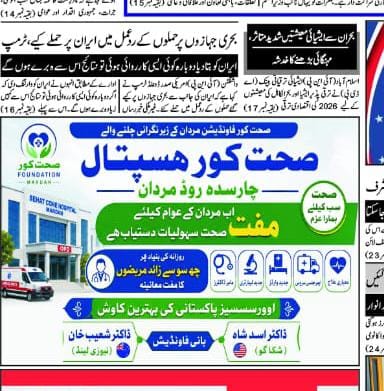
From Patient to Physician: Why We Must Replace Short-Term Charity with Sustainable Healthcare
As a CML survivor and internal medicine trainee, I watched Pakistan’s healthcare system fail those who needed it most. Beside my co-founders, Dr. Asad Shah and Dr. Shuaib, we built a paperless, self-sustaining social enterprise to restore dignity to medicine.
By Dr. Luqman Hakim
Every physician remembers the first time they delivered a life-altering diagnosis. But long before I ever wore a white coat, I was on the other side of that desk. I was the teenager listening to a doctor explain that the fatigue and pain consuming my body had a name: Chronic Myeloid Leukemia (CML).
In that quiet clinic room, my world fractured. To be young and diagnosed with blood cancer is to feel your future evaporate before it has even begun. Yet, it was during those grueling months of treatment, navigating the sterile, often indifferent corridors of oncology wards, that a quiet resolve took root within me. I watched my family scramble for resources, witnessed the silent agony of patients beside me who had run out of options, and realized that healthcare is not merely a clinical field—it is a battleground for human dignity.
I survived. Not just to live, but to practice. I resolved to become the doctor I needed when I was sick.
Years later, as an FCPS Internal Medicine trainee, I found myself walking those same hospital corridors, this time with a stethoscope around my neck. But the view from the clinical side was sobering. Day after day, I watched impoverished patients walk through our doors, their eyes heavy with a dual tragedy: the physical toll of disease, and the crushing realization that they could not afford the cure.
In Pakistan, a single major illness can plunge an entire family into generational poverty. I saw fathers quietly pocketing prescriptions they had no hope of filling. I saw mothers choosing which of their children could see a doctor. The standard response in our society has always been traditional, short-term charity—handouts that offer temporary relief but do nothing to cure the systemic rot.
I realized I could not wait until my residency was complete to act. The crisis was unfolding in front of me in real-time. I needed to build a solution that did not just treat patients, but reshaped how healthcare is delivered in Pakistan.
But I couldn't do it alone.
The Co-Founders' Alliance: Turning a Vision into Reality
When I first conceived the rough blueprint of what would become Sehat Kor, the conventional wisdom from critics was simple: if you want to help the poor, build a free clinic and rely entirely on donor handouts. I knew that model was broken. It was unstable, often stripped patients of their dignity, and collapsed the moment donations dried up. I envisioned a social enterprise healthcare model—but transforming this radical theory into a functioning, scalable reality required brilliant minds and unwavering allies.
That was the turning point when Dr. Asad Shah and Dr. Shuaib stepped forward.
As my co-founders, Dr. Asad Shah and Dr. Shuaib brought not just clinical credibility, but invaluable mentorship, strategic vision, and tireless hands-on support. They refused to let Sehat Kor become just another fleeting medical camp. Instead, they stood by me in the trenches, challenging the status quo and helping to build a permanent, high-quality, and highly sustainable social healthcare model.
Through late-night brainstorming sessions, operational hurdles, and the initial skepticism of the medical community, their belief in this mission never wavered. Together as co-founders, we established a core philosophy: to provide high-quality, affordable healthcare with dignity to both deserving and paying patients alike.
We designed a space where a wealthy businessman and a daily-wage laborer sit in the same clean, air-conditioned waiting area, receive consultations from the same highly qualified specialists, and are treated with the exact same level of respect. In our clinics, poverty is not a barrier to quality, and wealth does not buy a different class of empathy.
Innovation in Action: The Sehat Kor Blueprint
To make this vision viable, our co-founding team had to systematically dismantle and rebuild the traditional clinical workflow. Together, we designed and introduced several key innovations that have since defined the Sehat Kor model as a pioneer of healthcare innovation in Pakistan:
1. The Copayment and Token-Based Model
We rejected the notion of entirely free healthcare. Instead, we introduced a copayment healthcare model utilizing token-based, highly subsidized consultation charges. Even our most impoverished patients pay a nominal token fee. This small contribution is vital: it preserves the patient's self-respect, transforming them from passive recipients of charity into active consumers of healthcare who have a right to demand quality.
2. A Rigorous Four-Step Verification System
To ensure that financial assistance reaches those who genuinely need it, we developed a robust, objective verification system. Instead of relying on subjective impressions, every patient seeking subsidized care undergoes a standardized, four-step assessment analyzing their household income, living conditions, dependents, and medical urgency. This guarantees absolute transparency and ensures that donor funds are directed with mathematical precision to the most vulnerable.
3. A Fully Digital, Paperless Ecosystem
One of our proudest achievements is our transition to a completely paperless clinic. From the moment a patient registers at the reception to the doctor’s desk and the pharmacy counter, every interaction is logged via custom-built, secure digital medical records. This eliminating of paper charts has drastically reduced operational costs, minimized clinical errors, optimized patient wait times, and allowed us to track longitudinal health outcomes with incredible accuracy.
[Patient Registration]
│
▼
[4-Step Digital Verification] ──► (Determines subsidy level: Copay vs. Supported)
│
▼
[Paperless Specialist Consultation] ──► (Electronic Medical Records logged instantly)
│
▼
[Digital Pharmacy & Lab Integration] ──► (Automated inventory & precise dispensing)
4. Standardized Clinical Workflows
By optimizing our clinical workflows and implementing strict inventory controls, we have significantly reduced healthcare costs without compromising clinical outcomes. We operate with lean administrative overhead, ensuring that every rupee saved is directly reinvested into patient care.
The Power of Scale: Over 75,000 Lives Impacted
The true measure of any healthcare model lies in its clinical impact. Today, the foundation that Dr. Asad Shah, Dr. Shuaib, and I built from the ground up has grown into a robust healthcare ecosystem that has proudly served more than 75,000 patients.
These are not just statistics; they are human lives. They are grandmothers receiving hypertension management that prevents a catastrophic stroke; children treated for acute respiratory infections before they become life-threatening; and laborers receiving timely specialist interventions that allow them to return to work and support their families.
Sehat Kor Foundation: Key Metrics at a Glance
┌──────────────────────────────────────┬────────────────────────────────────────┐
│ Metric │ Status / Value │
├──────────────────────────────────────┼────────────────────────────────────────┐
│ Total Patients Served │ 75,000+ │
│ Clinical Records │ 100% Digital & Paperless │
│ Operational Self-Sustainability │ 48% (Generated via service revenue) │
│ Philanthropic Funding Requirement │ 52% (Donations & Zakat) │
└──────────────────────────────────────┴────────────────────────────────────────┘
This hybrid model benefits both ends of the socioeconomic spectrum. For paying patients, we offer an efficient, high-quality, and transparent alternative to expensive private hospitals. For deserving patients, we provide a lifeline. By serving paying patients, we generate internal revenue that directly subsidizes the care of those who cannot pay, creating a beautiful, self-sustaining loop of community care.
The Math of Compassion: Financial Sustainability
The tragedy of most nonprofit healthcare initiatives in developing nations is their fragility. When donations dry up, the clinics close, leaving vulnerable communities stranded. We refused to let Sehat Kor suffer this fate. Our leadership team built a financial engine designed to withstand economic shocks.
Our financial sustainability model is split with clinical precision:
* 48% of our operational costs are covered directly through our own service revenues (subsidized consultation tokens, pharmacy margins, and diagnostic services).
* 52% of our budget is met through philanthropy, Zakat, and corporate donations.
By generating nearly half of our own operating costs, Sehat Kor stands as one of Pakistan’s most financially sustainable and resilient nonprofit healthcare models. Every rupee donated to us goes twice as far because it is anchored by a self-sustaining business model. We do not ask donors to keep our lights on; we ask them to help us scale an engine that is already running.
The Personal Toll: Balancing the Stethoscope and the Blueprint
Leading this movement has not been without its deep personal challenges. Balancing the relentless demands of being an FCPS trainee in internal medicine while serving as the Founder & CEO of a rapidly growing healthcare organization has pushed me to my absolute limits.
There are nights when, after a grueling 30-hour on-call shift at the residency hospital, managing critically ill patients, my "rest" consists of opening my laptop to review Sehat Kor’s financial ledger, troubleshoot software bugs in our electronic medical records, or coordinate with Dr. Asad Shah and Dr. Shuaib on our scaling strategies.
I have missed family gatherings, sacrificed sleep, and lived in a state of perpetual exhaustion. As a CML survivor doctor, I am acutely aware of my own physical limitations. The ghost of my past illness occasionally whispers warnings of burnout.
But then, I walk into a Sehat Kor clinic. I see the incredible dedication of my co-founders and team, and I watch a mother smile because she received top-tier pediatric care for her child for less than the cost of a cup of tea, without having to beg for a favor or wait in a demeaning line. In those moments, the exhaustion evaporates. The sacrifices cease to feel like losses; they become the privilege of a lifetime. I was spared by cancer for a reason, and that reason is alive in the waiting rooms of Sehat Kor.
A Call to Action: Let Us Build a Sustainable Future
Pakistan’s healthcare crisis cannot be solved by simply building more charity hospitals that rely entirely on the shifting winds of donor goodwill. We cannot heal a nation through emergency handouts.
We must shift our collective mindset. We must move from emotional, short-term charity to structured, sustainable social enterprises.
I invite my fellow healthcare professionals, visionary philanthropists, corporate leaders, and policymakers to join us. Invest in models that champion self-reliance, leverage technology to reduce costs, and treat patients as partners in their own healing.
Support the Sehat Kor Foundation—not merely as an act of charity, but as an investment in a smarter, more dignified, and self-sustaining future for Pakistan's healthcare system.
We have proven that a paperless, dignified, and highly sustainable healthcare model is not an idealistic dream. It is operating right now, having served 75,000 lives and counting. Together, let us scale this blueprint until quality healthcare is no longer a luxury for the few, but a basic, dignified right for every single citizen of our country.
As a CML survivor and internal medicine trainee, I watched Pakistan’s healthcare system fail those who needed it most. Beside my co-founders, Dr. Asad Shah and Dr. Shuaib, we built a paperless, self-sustaining social enterprise to restore dignity to medicine.
By Dr. Luqman Hakim
Every physician remembers the first time they delivered a life-altering diagnosis. But long before I ever wore a white coat, I was on the other side of that desk. I was the teenager listening to a doctor explain that the fatigue and pain consuming my body had a name: Chronic Myeloid Leukemia (CML).
In that quiet clinic room, my world fractured. To be young and diagnosed with blood cancer is to feel your future evaporate before it has even begun. Yet, it was during those grueling months of treatment, navigating the sterile, often indifferent corridors of oncology wards, that a quiet resolve took root within me. I watched my family scramble for resources, witnessed the silent agony of patients beside me who had run out of options, and realized that healthcare is not merely a clinical field—it is a battleground for human dignity.
I survived. Not just to live, but to practice. I resolved to become the doctor I needed when I was sick.
Years later, as an FCPS Internal Medicine trainee, I found myself walking those same hospital corridors, this time with a stethoscope around my neck. But the view from the clinical side was sobering. Day after day, I watched impoverished patients walk through our doors, their eyes heavy with a dual tragedy: the physical toll of disease, and the crushing realization that they could not afford the cure.
In Pakistan, a single major illness can plunge an entire family into generational poverty. I saw fathers quietly pocketing prescriptions they had no hope of filling. I saw mothers choosing which of their children could see a doctor. The standard response in our society has always been traditional, short-term charity—handouts that offer temporary relief but do nothing to cure the systemic rot.
I realized I could not wait until my residency was complete to act. The crisis was unfolding in front of me in real-time. I needed to build a solution that did not just treat patients, but reshaped how healthcare is delivered in Pakistan.
But I couldn't do it alone.
The Co-Founders' Alliance: Turning a Vision into Reality
When I first conceived the rough blueprint of what would become Sehat Kor, the conventional wisdom from critics was simple: if you want to help the poor, build a free clinic and rely entirely on donor handouts. I knew that model was broken. It was unstable, often stripped patients of their dignity, and collapsed the moment donations dried up. I envisioned a social enterprise healthcare model—but transforming this radical theory into a functioning, scalable reality required brilliant minds and unwavering allies.
That was the turning point when Dr. Asad Shah and Dr. Shuaib stepped forward.
As my co-founders, Dr. Asad Shah and Dr. Shuaib brought not just clinical credibility, but invaluable mentorship, strategic vision, and tireless hands-on support. They refused to let Sehat Kor become just another fleeting medical camp. Instead, they stood by me in the trenches, challenging the status quo and helping to build a permanent, high-quality, and highly sustainable social healthcare model.
Through late-night brainstorming sessions, operational hurdles, and the initial skepticism of the medical community, their belief in this mission never wavered. Together as co-founders, we established a core philosophy: to provide high-quality, affordable healthcare with dignity to both deserving and paying patients alike.
We designed a space where a wealthy businessman and a daily-wage laborer sit in the same clean, air-conditioned waiting area, receive consultations from the same highly qualified specialists, and are treated with the exact same level of respect. In our clinics, poverty is not a barrier to quality, and wealth does not buy a different class of empathy.
Innovation in Action: The Sehat Kor Blueprint
To make this vision viable, our co-founding team had to systematically dismantle and rebuild the traditional clinical workflow. Together, we designed and introduced several key innovations that have since defined the Sehat Kor model as a pioneer of healthcare innovation in Pakistan:
1. The Copayment and Token-Based Model
We rejected the notion of entirely free healthcare. Instead, we introduced a copayment healthcare model utilizing token-based, highly subsidized consultation charges. Even our most impoverished patients pay a nominal token fee. This small contribution is vital: it preserves the patient's self-respect, transforming them from passive recipients of charity into active consumers of healthcare who have a right to demand quality.
2. A Rigorous Four-Step Verification System
To ensure that financial assistance reaches those who genuinely need it, we developed a robust, objective verification system. Instead of relying on subjective impressions, every patient seeking subsidized care undergoes a standardized, four-step assessment analyzing their household income, living conditions, dependents, and medical urgency. This guarantees absolute transparency and ensures that donor funds are directed with mathematical precision to the most vulnerable.
3. A Fully Digital, Paperless Ecosystem
One of our proudest achievements is our transition to a completely paperless clinic. From the moment a patient registers at the reception to the doctor’s desk and the pharmacy counter, every interaction is logged via custom-built, secure digital medical records. This eliminating of paper charts has drastically reduced operational costs, minimized clinical errors, optimized patient wait times, and allowed us to track longitudinal health outcomes with incredible accuracy.
[Patient Registration]
│
▼
[4-Step Digital Verification] ──► (Determines subsidy level: Copay vs. Supported)
│
▼
[Paperless Specialist Consultation] ──► (Electronic Medical Records logged instantly)
│
▼
[Digital Pharmacy & Lab Integration] ──► (Automated inventory & precise dispensing)
4. Standardized Clinical Workflows
By optimizing our clinical workflows and implementing strict inventory controls, we have significantly reduced healthcare costs without compromising clinical outcomes. We operate with lean administrative overhead, ensuring that every rupee saved is directly reinvested into patient care.
The Power of Scale: Over 75,000 Lives Impacted
The true measure of any healthcare model lies in its clinical impact. Today, the foundation that Dr. Asad Shah, Dr. Shuaib, and I built from the ground up has grown into a robust healthcare ecosystem that has proudly served more than 75,000 patients.
These are not just statistics; they are human lives. They are grandmothers receiving hypertension management that prevents a catastrophic stroke; children treated for acute respiratory infections before they become life-threatening; and laborers receiving timely specialist interventions that allow them to return to work and support their families.
Sehat Kor Foundation: Key Metrics at a Glance
┌──────────────────────────────────────┬────────────────────────────────────────┐
│ Metric │ Status / Value │
├──────────────────────────────────────┼────────────────────────────────────────┐
│ Total Patients Served │ 75,000+ │
│ Clinical Records │ 100% Digital & Paperless │
│ Operational Self-Sustainability │ 48% (Generated via service revenue) │
│ Philanthropic Funding Requirement │ 52% (Donations & Zakat) │
└──────────────────────────────────────┴────────────────────────────────────────┘
This hybrid model benefits both ends of the socioeconomic spectrum. For paying patients, we offer an efficient, high-quality, and transparent alternative to expensive private hospitals. For deserving patients, we provide a lifeline. By serving paying patients, we generate internal revenue that directly subsidizes the care of those who cannot pay, creating a beautiful, self-sustaining loop of community care.
The Math of Compassion: Financial Sustainability
The tragedy of most nonprofit healthcare initiatives in developing nations is their fragility. When donations dry up, the clinics close, leaving vulnerable communities stranded. We refused to let Sehat Kor suffer this fate. Our leadership team built a financial engine designed to withstand economic shocks.
Our financial sustainability model is split with clinical precision:
* 48% of our operational costs are covered directly through our own service revenues (subsidized consultation tokens, pharmacy margins, and diagnostic services).
* 52% of our budget is met through philanthropy, Zakat, and corporate donations.
By generating nearly half of our own operating costs, Sehat Kor stands as one of Pakistan’s most financially sustainable and resilient nonprofit healthcare models. Every rupee donated to us goes twice as far because it is anchored by a self-sustaining business model. We do not ask donors to keep our lights on; we ask them to help us scale an engine that is already running.
The Personal Toll: Balancing the Stethoscope and the Blueprint
Leading this movement has not been without its deep personal challenges. Balancing the relentless demands of being an FCPS trainee in internal medicine while serving as the Founder & CEO of a rapidly growing healthcare organization has pushed me to my absolute limits.
There are nights when, after a grueling 30-hour on-call shift at the residency hospital, managing critically ill patients, my "rest" consists of opening my laptop to review Sehat Kor’s financial ledger, troubleshoot software bugs in our electronic medical records, or coordinate with Dr. Asad Shah and Dr. Shuaib on our scaling strategies.
I have missed family gatherings, sacrificed sleep, and lived in a state of perpetual exhaustion. As a CML survivor doctor, I am acutely aware of my own physical limitations. The ghost of my past illness occasionally whispers warnings of burnout.
But then, I walk into a Sehat Kor clinic. I see the incredible dedication of my co-founders and team, and I watch a mother smile because she received top-tier pediatric care for her child for less than the cost of a cup of tea, without having to beg for a favor or wait in a demeaning line. In those moments, the exhaustion evaporates. The sacrifices cease to feel like losses; they become the privilege of a lifetime. I was spared by cancer for a reason, and that reason is alive in the waiting rooms of Sehat Kor.
A Call to Action: Let Us Build a Sustainable Future
Pakistan’s healthcare crisis cannot be solved by simply building more charity hospitals that rely entirely on the shifting winds of donor goodwill. We cannot heal a nation through emergency handouts.
We must shift our collective mindset. We must move from emotional, short-term charity to structured, sustainable social enterprises.
I invite my fellow healthcare professionals, visionary philanthropists, corporate leaders, and policymakers to join us. Invest in models that champion self-reliance, leverage technology to reduce costs, and treat patients as partners in their own healing.
Support the Sehat Kor Foundation—not merely as an act of charity, but as an investment in a smarter, more dignified, and self-sustaining future for Pakistan's healthcare system.
We have proven that a paperless, dignified, and highly sustainable healthcare model is not an idealistic dream. It is operating right now, having served 75,000 lives and counting. Together, let us scale this blueprint until quality healthcare is no longer a luxury for the few, but a basic, dignified right for every single citizen of our country.